

Overview
The turquoise glacial water and rocky shoreline stand in for the Long Lake surrounding Lake-town
Around 700 people worked this lakeshore, and none of that shoot is still there. Lake-town was filmed in three places.
The practical wet set was built on the Stone Street Studios lot in Wellington, the real shoreline came from Tasman Downs Station on Lake Pukaki's eastern edge in Canterbury, where The Hobbit: The Battle of the Five Armies refugee scenes were shot, and Wētā Digital built the town itself.
In real life, Lake-town's Long Lake is Lake Pukaki, a glacier-fed lake in the Mackenzie Basin. The turquoise colour comes from glacial flour, rock ground superfine by the glaciers above and left suspended in the meltwater.
Tasman Downs is a private working high-country station, so this Laketown filming location is one you look at from the road.
Scene & Film
Lake Pukaki is the lake behind Lake-town. It stood in for the Long Lake, the water Esgaroth sits on in Tolkien's Middle-earth.
Peter Jackson filmed this region three times across both trilogies, drawn by the water colour and the light, and the Southern Alps behind it fed the Misty Mountains backdrops.
Esgaroth, Tolkien's name for Lake-town, reached the screen as a practical set in Wellington extended digitally by Wētā, so the Laketown filming location splits three ways.
Lake-town features in both The Hobbit: The Desolation of Smaug and The Hobbit: The Battle of the Five Armies, and the Tasman Downs shoreline belongs to the second, where survivors come ashore after Smaug destroys the town.
Dale sat upriver on the River Running and did its trade with the dwarves under the Lonely Mountain until Smaug took it.
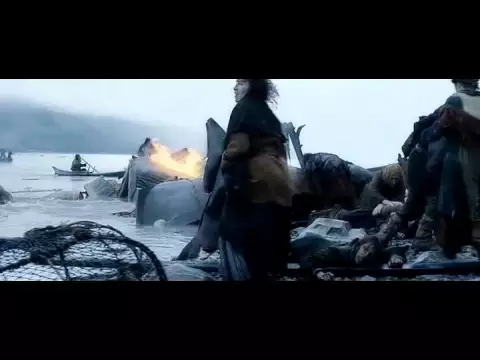 On-location scene
This page contains affiliate links. If you book through one of them, we may earn a small commission at no extra cost to you. Read our affiliate disclosure.
Tekapo Shuttle: Mt Cook Day Tour via Pukaki & Tasman Lake
Prefer a guided trip? See the tour we picked for this area.
View Mt Cook Day TourHow to visit
The set was dismantled after filming and the station is private working farmland. The lake itself is fully accessible: from the SH8/SH80 junction south of Twizel, drive north on SH80 to the Lake Pukaki lookout, free and signposted with toilets.
Hayman Road on the eastern shore is unsealed and ends at a locked gate.
- Coordinates
- -44.0204, 170.1958 · 44°01′13.4″S 170°11′44.9″E
- Access
- Public
- Official info
- Laketown / Shores of the Long Lake official info
The lake is free to see; Tasman Downs is private farmland with no public access. Hobbit fans visiting Lake Pukaki get the Long Lake shoreline from Tapataia Mahaka / Peters Lookout on SH80, about 15 km toward Aoraki/Mount Cook, or from the Lake Pukaki Visitor Centre on SH8 north of Twizel.
Tekapo Shuttle's Mount Cook day tour passes it, from around NZ$149.
Hayman Road, also off SH8, runs about 20 km down the eastern shore, the last 14 km unsealed. It does not reach the set pad.
Braemar Station sits on the same lake, and Ben Ohau Station 20 km south played the Pelennor Fields: three stations, one day's driving. New Zealand's longest suspension bridge, 189 m over the Hooker River, opened on 28 July 2026, so the Hooker Valley Track is whole again, about 5 km one way.
Take microspikes and poles for the icy shaded stretches.

Quick facts
- Middle-earth
- Laketown / Shores of the Long Lake
- Real-world
- Tasman Downs Station, Lake Pukaki, Canterbury
- Films
- The Hobbit: The Desolation of Smaug, The Hobbit: The Battle of the Five Armies
- Access
- Public
- Last updated
Behind the Scenes
No. Nothing remains at Lake Pukaki.
The Tasman Downs material was dismantled after filming, and the pad sits on private land behind a locked gate, with no public entry.
The practical Lake-town set in New Zealand went up instead at Stone Street Studios in Miramar, Wellington, a wet set standing in and around a shallow artificial lake, walled in by cement barriers, with a permanent green screen running down one side.
Pukaki gave one of the largest operational periods in the shooting schedule. Wētā Digital built the rest, part of close to 2,000 visual-effects shots the studio delivered for The Desolation of Smaug.
Its models department made 50 unique buildings, eight unique bridges and six towers, dressed and rescaled to fill 200,000 square metres with up to 1,500 buildings visible in some shots, over two million planks of wood, more than five million roof tiles and 1,749 walkways.
Want the full production story?
Ian Brodie's Middle-earth Landscapes covers the Hobbit and Lord of the Rings locations together, with behind-the-scenes stories, maps and location photography.
Places to stay for visiting Laketown
Places to stay for a visit to Laketown.
Find a place to stayNearby filming locations
Pair your visit to Laketown / Shores of the Long Lake with these other Lord of the Rings filming locations within driving distance.
The Lonelands: Warg Chase (open plains), Braemar Station, Mackenzie Basin
Pelennor Fields: main battle, Ben Ohau Station, near Twizel
Ered Nimrais: Beacon Fires, Mount Gunn, near Franz Josef Glacier
Boromir and the Ring: Caradhras Climb, Rangitata River headwaters, inland Canterbury
Gallery


Been here? Share your visit
Add a note for the next person visiting Laketown / Shores of the Long Lake. Photos welcome.
No visitor notes yet. Be the first to leave one.